
The Three Circles
Why I needed a language for what caregiving really feels like

Some ideas live inside you for years before they find their shape.
This one did. It started during the most difficult chapter of my life — when my wife was going through a severe mental health challenge, and we were still relatively new to Australia. No extended family nearby. No safety net. Just two people in a country that wasn’t yet home, trying to hold things together while one of us was falling apart.
I didn’t have the language for what I was experiencing back then. I just knew it was heavy. And I knew that the people around us — kind, well-meaning people — didn’t quite see what it was costing me to hold that space. Not because they didn’t care. But because the weight I was carrying was invisible.
It took me a long time to understand that this wasn’t unique to my story. It’s a pattern. And once I started having conversations on Fail With Me — listening to people share their own experiences of loss, illness, caregiving, and quiet collapse — I kept seeing the same shape emerge.
Three circles.
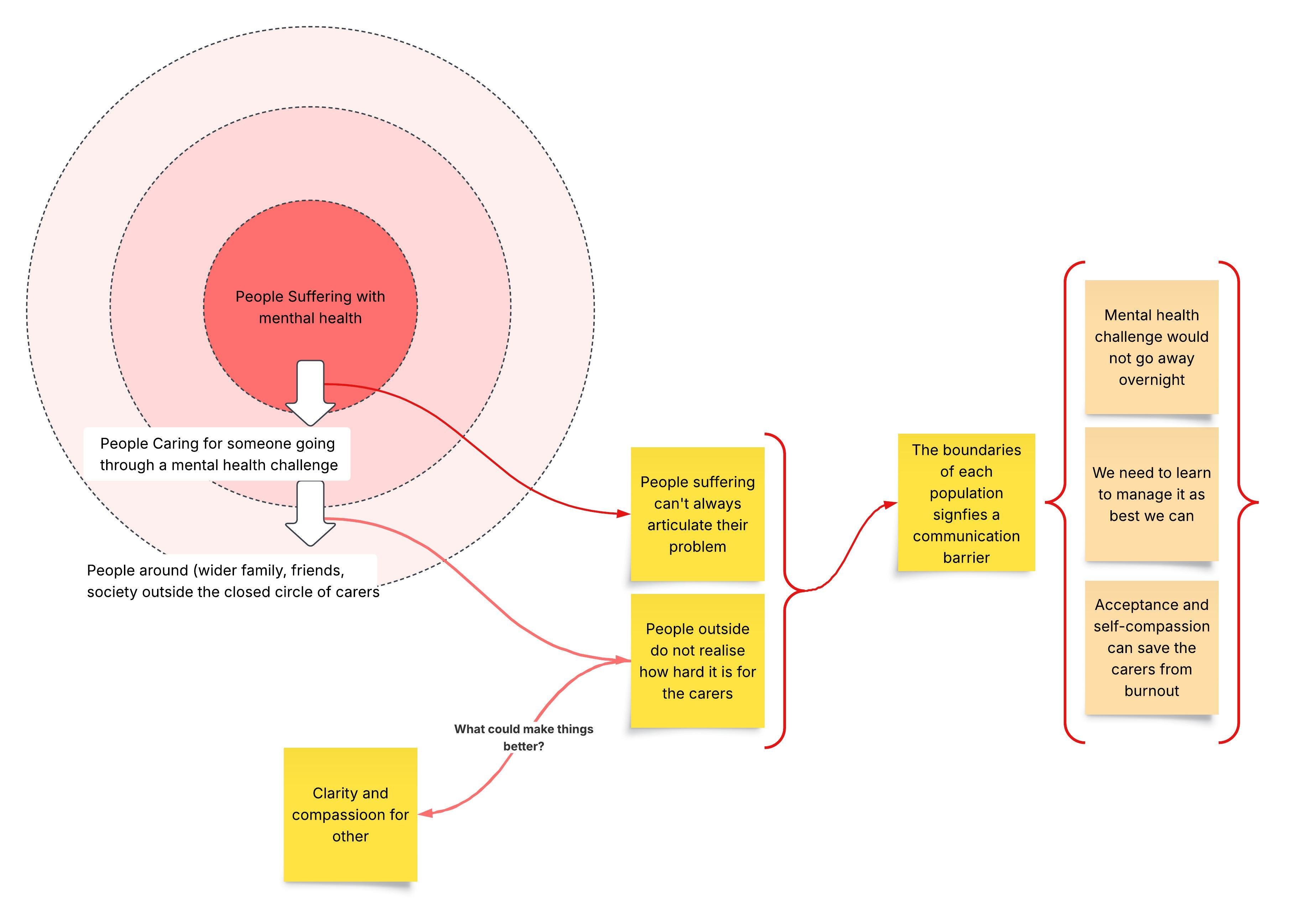
The innermost circle holds the person who is suffering. The one living with the mental health challenge. And what we don’t talk about enough is this: they often can’t articulate what’s wrong. Not because they don’t want to — but because the experience resists language. It’s like asking someone to describe the shape of water while they’re drowning in it. The words don’t come. Or when they do, they don’t land the way they were meant to.
The middle circle is where the caregivers live. Partners, family members, the people who show up every single day. They’re holding someone up, but quietly. Absorbing someone else’s pain while managing their own. From the outside, they look fine — functioning, working, keeping things together. But inside, they’re carrying a weight that nobody handed them. They just picked it up, because someone had to.
The outer circle is the wider world — extended family, friends, colleagues, society. People who often care genuinely, but who don’t fully understand what’s happening in those inner circles. And how could they? They’re not in the room at two in the morning. They’re not sitting in the silence. Sometimes, they question what they can’t see. And for the person in the middle circle, that doubt can feel like a second weight on top of the one they’re already carrying.
The thing I keep coming back to is this: the boundaries between these circles aren’t just lines. They’re communication barriers. The person suffering can’t always reach the carer with their words. And the carer can’t always reach the outer circle with theirs. Everyone is trying to connect, but the language breaks down at each boundary.
In that gap — in that silence — is where so much of the invisible weight lives.
I had a conversation recently with someone who’s going to be a guest on the podcast — Melissa. She’s been through her own caregiving journey with her husband, and as we talked, this model came up naturally. She understood it immediately. Not because I explained it well, but because she’d lived it.
After our call, I sat down and drew the diagram you see in this post. It was the first time I’d put it on paper. And recording the piece you’ll find below was the first time I’d spoken it aloud in its entirety.
I’m sharing it now because I think it’s ready. Not perfect — but ready. And because every time I have one of these conversations, I’m reminded that there are people sitting in that middle circle right now, wondering why no one sees them.
This is for them.
Mental health challenges don’t disappear overnight. We don’t get to fix them. We get to learn to manage them — day by day. And for caregivers, the thing that keeps us from burning out isn’t strength. It’s self-compassion. Permission to not be okay. Permission to say: I’m carrying something heavy, and I need someone to see that.
What could make things better? I think it comes down to two things: clarity and compassion. From every circle, toward every other.
If this resonated, I’d love to hear from you — in the comments, or wherever you find me. And if you know someone in that middle circle, maybe share this with them. Sometimes, knowing someone sees you is the most powerful thing.
Abhra
You can find more episodes of Stories and Stanza on Spotify, Apple Podcasts, and wherever you listen.
Hi Abhra, this is exactly what I speak about in my new book! Spot on…in my experience there was so many compounding factors for me in the second circle. Look forward to chatting with you on our upcoming episode!